1th 12th

11th + 12th CBSE & State Board Commerce Coaching Classes in Nagpur | Vihaan Education

Best Commerce Coaching in Sitabuldi, Nagpur – Vihaan Education

Looking for the best 11th 12th Commerce Coaching Classes in Nagpur (State Board & CBSE Board)?

Vihaan Education provides expert coaching for Maharashtra State Board and CBSE Board students with complete syllabus coverage, regular tests, and strong concept clarity.

We help students score high marks in board exams and build a strong foundation for

CA, CMA, CS, and other professional courses.


📍 Our Location – Easy to Reach in Sitabuldi

Address:
2nd Floor, VIHAAN EDUCATION
Keshav Imperial 205A
Near Shani Mandir
Sitabuldi, Nagpur, Maharashtra – 440012

🕒 Approx. 22 minutes travel (central Nagpur access)
📞 Phone: 075170 00369

Located in the prime area of Sitabuldi, our institute is easily accessible from Dharampeth, Sadar, Civil Lines, Mahal, and nearby areas.


Subjects Covered – State Board & CBSE

Maharashtra State Board

  • Book Keeping & Accountancy
  • Economics
  • Organisation of Commerce
  • Secretarial Practice
  • Mathematics & Statistics

CBSE Board

  • Accountancy
  • Business Studies
  • Economics
  • Mathematics

Strong Foundation for CA / CMA / CS

At Vihaan Education, students get early guidance for professional courses affiliated with:

  • Institute of Chartered Accountants of India (CA)
  • Institute of Cost Accountants of India (CMA)
  • Institute of Company Secretaries of India (CS)

Why Students Choose Vihaan Education?

✔ Experienced Faculty
✔ Board Pattern Test Series
✔ Regular Doubt Solving
✔ Personal Attention
✔ Career Guidance
✔ Affordable Fees


Admission Open – 11th & 12th Commerce Classes in Nagpur

If you are searching for:

  • 11th Commerce Coaching near Sitabuldi
  • 12th Commerce Classes in Nagpur
  • Best Commerce Coaching near Shani Mandir
  • State Board & CBSE Commerce Classes

👉 Visit Vihaan Education today or call 075170 00369 for demo lecture booking.

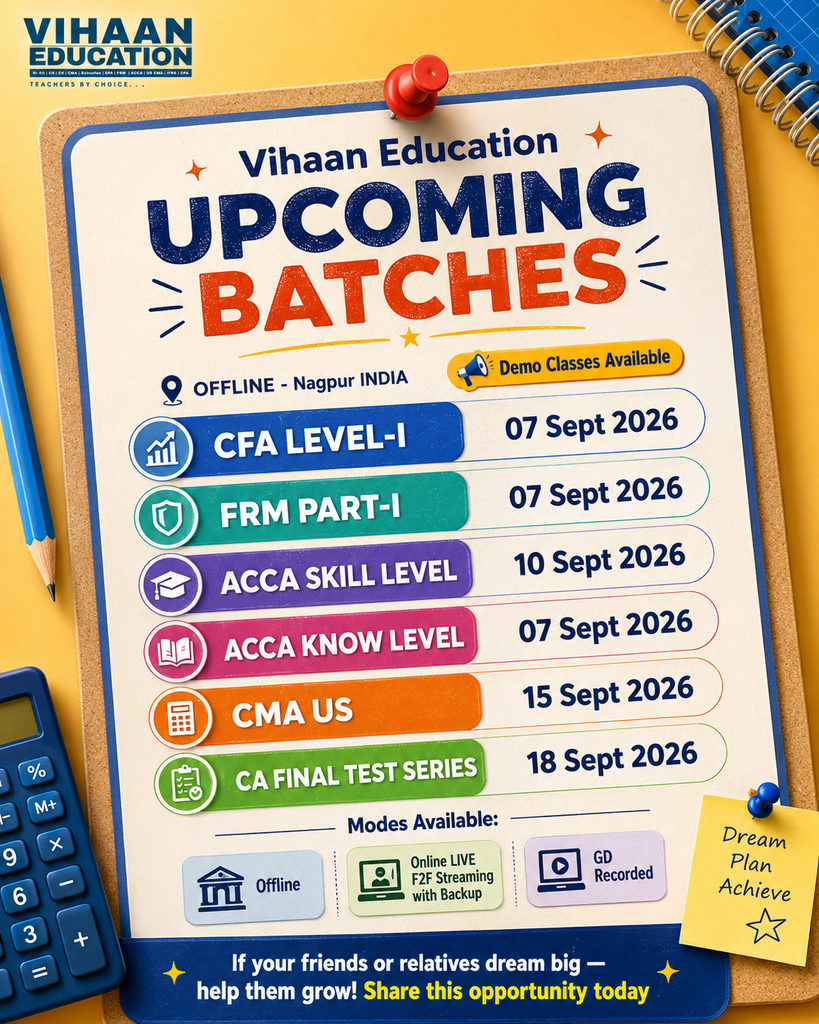
CA Foundation Sept 2026

CA Foundation Offline Coaching in Nagpur – Sitabuldi Batch (Sept 2026 – Jan/May 2027)

Looking for the best CA Foundation offline coaching in Sitabuldi Nagpur?
Join Vihaan Education and prepare with experienced CA faculty, structured classroom teaching, and complete exam-oriented guidance for Sept 2026 & Jan/May 2027 attempts.

If you are serious about cracking CA Foundation in your first attempt, this batch is designed with face-to-face learning, regular testing, mentorship, and digital backup support — everything under one roof.

📍 Why Choose Vihaan Education – Sitabuldi, Nagpur?

At Vihaan Education, we focus on concept clarity, disciplined preparation, and consistent test practice.

✔ Face-to-face classroom teaching
✔ Live at Home access
✔ Recorded lectures on Google Drive
✔ Hard copy books included
✔ 3 views per subject
✔ 1-year validity from date of enrollment
✔ Regular test series & performance analysis
✔ Personal mentorship & doubt-solving sessions

👨‍🏫 Expert CA Faculty Panel

Learn from experienced and result-oriented faculty:

  • CA CS Pavan Gahukar
  • CA Rushabh Kawle
  • CA Sumit Sarda
  • CA Tushar Taparia
  • Prof. Shashank Wandhe

Each subject is handled by a specialist faculty to ensure strong conceptual clarity and exam-focused preparation.

📚 Course Details – CA Foundation Offline Classroom Batch (March 2026)

Batch Type: Regular
Mode: Face to Face | Google Drive | Live at Home
Books: Hard Copy Books Included
Views: 3 Views
Validity: 1 Year

This course is specially structured for:

  • 📅 CA Foundation Sept 2026
  • 📅 CA Foundation Jan 2027
  • 📅 CA Foundation May 2027

📊 What You Get in This Course

  • Complete syllabus coverage as per ICAI latest pattern
  • Concept building from basics to advanced
  • Chapter-wise and full syllabus test series
  • Practice questions + RTP + MTP discussion
  • Time management strategies for exam
  • Regular progress tracking

📍 Location Advantage – Sitabuldi, Nagpur

Our classroom is centrally located in Sitabuldi, making it easily accessible from all major areas of Nagpur.

If you are searching for:

  • CA Foundation Classes in Nagpur
  • Best CA Coaching in Sitabuldi
  • Offline CA Foundation Batch Nagpur
  • CA Foundation Live + Recorded Classes

This batch is perfect for you.

📞 Enroll Now – Limited Seats Available

Start your CA journey with structured preparation and expert mentorship at Vihaan Education, Sitabuldi Nagpur.

Secure your seat today and take the first step toward becoming a Chartered Accountant. 🚀

GATEWAY TO A CAREER IN – Chartered Accountancy

Steps to Become a Chartered Accountant (CA)

Are you aspiring to become a Chartered Accountant? Vihaan Education is here to guide you through every step of the journey. Chartered Accountancy is a prestigious and rewarding profession, and the path to achieving this goal requires dedication and structured learning. Here’s a step-by-step guide to help you navigate through the CA journey.

• Appear for the Class 10th examination and register with the Board of Studies of ICAI.
• Complete a 4-month study period before attempting the CA Foundation exam (registration deadlines: before 1st February & 1st August for June & December exams respectively).
• Collect study materials and prepare thoroughly.
• After qualifying Class 12th and completing the study period, appear for the Exam Details: CA Foundation exam held three times a year in January, May, and September.

CA Foundation Exam Overview

The CA Foundation exam consists of four subjects:

Paper 1: Accounting (100 Marks)
Paper 2: Business Law (100 Marks)
Paper 3: Quantitative Aptitude (100 Marks) (Objective with negative marking of 0.25 per wrong answer)
Paper 4: Business Economics (100 Marks) (Objective with negative marking of 0.25 per wrong answer)

Exam Details:

• Total Marks: 400
• Passing Marks: Minimum 200 (with at least 40 marks in each subject)
• Foundation Registration Fee: ₹9,000/-

• Register with ICAI for the Intermediate Course.
• Undergo 8 months of self-study before appearing for the exams.
• Complete the 4-week Integrated Course on Information Technology and Soft Skills (ICITSS) before starting practical training.
• Exams are held three times a year in January, May, and September.

Subjects of CA Intermediate

Group I :

Paper 1: Advanced Accounting
Paper 2: Corporate Laws & Other Laws
Paper 3: Taxation

Group II:

Paper 4: Cost and Management Accounting
Paper 5: Auditing and Ethics
Paper 6A: Financial Management
Paper 6B: Strategic Management

Registration Fee: ₹18,000/- (Both Groups)

Exam Details:

• Total Marks : 600 (300 per group)
• Passing Marks : Minimum 40 marks per paper and 50% aggregate in each group 
• Negative marking applies to objective-type questions

Articleship Training

• Begins after clearing both groups of CA Intermediate and completing ICITSS.
• Join as an Article Assistant under a practicing CA for 2 years.
• Complete Advanced ICITSS (AICITSS) during the last two years of training.
• ICAI offers Self-Paced Online Learning Modules:
Set A: Corporate & Economic Laws
Set B: Strategic Cost & Performance Management
Set C (Elective): Options like Risk Management, Valuation, Forensic Accounting, etc.
Set D: Topics including Entrepreneurship, Digital Ecosystem, Psychology & Philosophy

• Register for CA Final Course after clearing CA Intermediate.
Registration Fee: ₹22,000/-
• Appear for the Final Examination after completing 2 years of practical training.
• Exams are held in May and November every year.

Subjects of CA Final

Group I:

Paper 1: Financial Reporting
Paper 2: Advanced Financial Management
Paper 3: Advanced Auditing, Assurance, and Professional Ethics

Group II:

Paper 4: Direct Tax Laws & International Taxation
Paper 5: Indirect Tax Laws
Paper 6: Integrated Business Solutions

Scope of a Chartered Accountant

✔ Independent Practice: Set up your own CA firm.
✔ Freelancing Opportunities: Work as a consultant for taxation, accounting, and financial management on a project basis.
✔ Management Consultancy: Work in financial management, project reports, and system analysis.
✔ Corporate Jobs: Secure high-paying jobs in multinational corporations, banks, and finance firms.
✔ Government & Public Sector: Opportunities in RBI, SEBI, and PSU companies.
✔ International Scope: ICAI certification is recognized in UK, Australia, Canada, and UAE.
✔ Entrepreneurship: Many CAs successfully run their businesses or family enterprises.
✔ Women in CA: Provides flexibility and financial independence.

Why Choose Vihaan Education?

✅ Expert Faculty with Proven Track Record

✅ Comprehensive Study Material

✅ Regular Mock Tests & Doubt-Solving Sessions

✅ Personalized Mentorship & Career Guidance

📞 Call/WhatsApp: 7517000369 / 9850322529📧

Email: vihaaneducations@gmail.com

🌐 Website: Vihaan Education

Start your journey towards becoming a Chartered Accountant with Vihaan Education today!

what is acca

What is ACCA : Eligibility, Course Details, Certificate, Jobs & Salary

Association of Chartered Certified Accountants is the name of the organisation. ACCA is a worldwide accounting organisation that was founded in 1904 and provides “Certified Chartered Accountant” accreditation.  The length of an ACCA course varies depending on the students’ educational background. The ACCA programme lasts three years for students who have finished their 12th grade, two to two and a half years for commerce graduates, two years for IPCC groups, and one year for B.Com and CA graduates.

According to the ACCA eligibility requirements, students must be at least 18 years old, have finished the 10+2, and have an overall score in math/accounting and English of 65%, as well as an overall score in all other disciplines of at least 50%. Students earning BCom, BBA, BMS, and other business- or commerce-related degrees may also apply for the ACCA course concurrently with graduation. The identical ACCA qualifying requirements are accepted and followed by all universities and institutes.

ACCA Course Details

Given below are the important details of the ACCA course program:

ACCA Full Form Association of Certified Chartered Accountants
Course Level Professional
ACCA Course Duration 1-7 years
ACCA Course Fees INR 28,000 to INR 2,60,000
ACCA Exams 13 exams
ACCA Eligibility Criteria 10+2 with minimum 65% aggregate in Maths/Accounts and English, and 50% in other subjects
ACCA Admission Merit and entrance exam based followed by interview round


ACCA Career Prospects Accountants, Auditors, Finance manager, Business Analyst, Taxation Expert
ACCA Average Salary INR 3.5 to 4 LPA
Top ACCA Recruiters PwC, EY, Deloitte, KPMG, Grant Thornton

What is ACCA?

  • With over 200,000 members and 600,000 students in over 180 countries, the Association of Chartered Certified Accountants, or ACCA as it is more often known, is a certification programme that is widely recognised.
  • Students who desire to pursue a successful career in accounting greatly prize the ACCA, which is one of the most respected certificates in the sector.
  • Since ACCA is one of the most recognised degrees, it is relevant to every nation.
  • The ACCA is a high-level professional qualification based on worldwide accounting and auditing standards that is equal to receiving a full university degree.
  • The student’s degree programmes, such as B. Com, BBA, etc., can be pursued concurrently with the ACCA course. It can even be added to the degree programme itself.
  • The extremely flexible exam structure provided by ACCA makes it a desirable option for candidates seeking or already holding a graduate degree.
  • 13 necessary tests for ACCA must be passed in a maximum of 7 years.
  • Financial statements, managerial accounting, business taxation and regulations, audit, and business ethics are all covered by the ACCA certification.
  • The ACCA syllabus is both industry-relevant and internationally recognised, giving students a fantastic opportunity to start a career in accounting and finance.

ACCA Eligibility

The following are the requirements for enrollment in the ACCA course:

  • Students must be older than 18 years old.
  • For students to be eligible for an ACCA course, they must at least have fulfilled the 10+2 requirement.
  • Students must have received at least 65% in both English and Accounts/Mathematics.
  • For students to be eligible for the ACCA course, all other subject grades must be at least 50%.

ACCA Admission 2023

There are two modes for admission into ACCA Course, which are as follows:

  1. Merit-based
  2. Entrance Exam Based

ACCA Entrance Exams

ACCA often does not demand entrance tests. To offer ACCA admissions, some colleges, on the other hand, administer entrance tests. The following is a list of the exams required for admission to ACCA courses:

ACCA exam Conducting Body Exam Mode
CUET Christ University Online
AIMA UGAT All India Management Association Online
SET Symbiosis University  Offline
SUAT Sharda University Online

Merit Based Admission Process

The detailed admissions procedure used by institutions like Apeejay Stya University in Gurgaon, which offers merit-based ACCA admissions, is provided below:

Step 1: Fill out and submit the application form in some colleges only accept online applications, while others accept both. Students must fill out the application form either online or offline.

Step 2: Upload documents: After filling out the required fields on the application form, students must scan and upload the necessary documents to the admissions portal for admission and verification.

The third step is paying the application cost, which differs from college to college. Then, by SMS or email, they will get their application number.

Step 4: Application review and shortlisting of candidates: The admissions staff at the university will choose applicants after analysing student applications to see whether they fit the requirements. These students will now be contacted in order to take part in group discussions and rounds of personal interviews (PI).

 Step 5: Group discussions (GD) and individual interviews constitute.Some universities hold GD and PI rounds to find out more about the candidate’s background and character in light of the standards the university has for its students.

Merit Based Admission Process

The detailed admissions procedure used by universities like Christ University, Bangalore, which offers ACCA admissions based on entrance exam, is provided below:

First, complete and submit the application form.

Step 2: Upload the required files.

Step 3: Pay the application fee.

Step 4 : Register for the entrance exam in step four. The student must register for the entrance exam before the deadline if the institution to which they have applied does not automatically do so.

Step 5 : Candidate shortlisting in step five: The university will choose students based on the outcomes of the entrance exams. The persons who made the short list will be contacted for additional verification.

Step 6 : Only those applicants who have been shortlisted will be contacted for personal interviews and document verification. Candidates that are judged eligible will be admitted to the course.

ACCA Syllabus

The syllabus for ACCA is divided into 13 exams and 3 course levels, which are:

  1. Knowledge
  2. Skills
  3. Professional

The detailed ACCA subjects for each level are given below:

ACCA Subjects: Knowledge Level

  • Business Accounting 
  • Financial Accounting
  • Management Accounting 

ACCA Subjects: Skills Level

  • Corporate and Business Laws
  • Performance Management
  • Taxation 
  • Financial Reporting 
  • Audit and Assurance 
  • Financial Management 

ACCA Subjects: Professional Level

Compulsory ACCA Subjects

Optional ACCA Subjects (Any 2)

  • Strategic Business Leadership
  • Strategic Business Reporting
  • Advanced Financial Management
  • Advanced Performance Management
  • Advanced Taxation
  • Advanced Audit and Assurance

Candidates must present proof of 36 months of pertinent experience after completing all 13 ACCA tests. applicants should also complete the Ethics and Professional abilities Module, which helps applicants develop all the abilities that companies look for.

ACCA Exams

Given below is the list of the ACCA papers, which candidates must clear to earn ACCA certification:

  1. Audit and Assurance (AA)
  2. Taxation (TX) 
  3. Performance Management (PM)
  4. Financial Reporting (FR)
  5. Financial Management (FM)
  6. Advanced Audit and Assurance (AAA)
  7. Advanced Taxation (ATX)
  8. Advanced Performance Management (APM)
  9. Strategic Business Reporting (SBR) 
  10. Advanced Financial Management (AFM)
  11. Strategic Business Leader (SBL)
  12. Advanced Taxation (ATX)
  13. Corporate and Business Law (LW)

ACCA Exemptions

Depending upon the qualifications, there are certain exemptions for ACCA Exams for students, which are listed below:

Qualification

Number of Exams

ACCA Exemptions

12th Pass 13 None
Commerce Graduate 9 BT, MA, FA, LW
CA IPCC (both) 8 BT, MA, FA, TX, AA
CA 4 BT-FM (9 subjects)

ACCA Course Comparison

This section compares the ACCA course to related programmes like CA, CS, and CPA in terms of prerequisites, length, cost, eligibility, admission, and other important elements.

ACCA vs CA

A globally recognised accreditation for accounting education is the ACCA. Similar accounting credentials are offered in India by the ICAI through the Chartered Accountancy (CA) programme. Knowing the differences between ACCA and CA can help you decide which is the better option for you.

Features

ACCA  (Association of Certified Chartered Accountants)

CA (Chartered Accountant)

Qualification Type Professional Professional
Aim Provides technical expertise in accounts and finance for superior management roles in the domain of accountancy It prepares students to work in taxation and auditing firms by educating them on the concepts of accounts and taxation.
Certifying Agency Association of Certified Chartered Accountants provides ACCA certification. Institute of Chartered Accountants of India (ICAI) administers CA certification.
Course Duration 1-7 years 5 years
Course Fees INR 65,000 to 2,50,000 INR 20,000 to 2,50,000
Examination Type 13 exams in CBE mode 3 exams
Eligibility 10+2 with minimum 65% in Accounts/Maths and English, 50% in other subjects 10+2 with 4 months study period, or

BCom with minimum 50% marks

Admission Process Merit and entrance based Entrance Exams
Top Colleges Christ University, Symbiosis College of Art and Commerce, Apeejay Stya University Institute of Chartered Accountants of India, Noida, Indian Institute of Finance and Accounts, Pune, International School of Financial Studies, Secunderabad, etc.
Career Options Accountant, internal auditor, compliance officer, business analyst, risk manager, treasurer, business consultant, chief financial officer (CFO), etc. Accountants, Auditors, Financial Officer, Finance Manager, Taxation Expert, Investment Advisor, etc
Average Salary INR 3.5-4 LPA INR 6-8 LPA

ACCA vs CS

The Company Secretary (CS) degree focuses exclusively on the financial and legal aspects of a corporation, whereas the ACCA course prepares students to be financial officers and accountants. The two courses are thoroughly compared here in terms of prerequisites, length, prices, admission requirements, and more:

Features

ACCA  (Association of Certified Chartered Accountants)

CS (Company Secretary)

Qualification Type Professional Professional
Aim Provides technical expertise in accounts and finance for superior management roles in the domain of accountancy It prepares students for the top-level jobs in the company. It trains the students in taxation, legal laws, regulations, banking, etc.
Certifying Agency Association of Certified Chartered Accountants Institute of Company Secretaries of India (ICSI)
Course Duration 1-7 years 3 years
Course Fees INR 65,000 to 2,50,000 INR 10,000 to INR 50,000
Examination Type 13 exams in CBE mode 3 exams
Eligibility 10+2 with minimum 65% in Accounts/Maths and English, 50% in other subjects 10+2
Admission Process Merit and entrance based Entrance Exam
Top Colleges Christ University, Symbiosis College of Art and Commerce, Apeejay Stya University ICSI
Career Options Accountant, internal auditor, compliance officer, business analyst, risk manager, treasurer, business consultant, chief financial officer (CFO), etc. Company Secretary, Legal Manager, Executive Officer, Director, etc
Average Salary INR 3.5-4 LPA INR 4-8 LPA

ACCA vs CPA

The tabled form below details the distinctions between the ACCA and Certified Public Accountants (CPA) programmes in the USA based on factors including prerequisites, tests, length, costs, typical salaries, and more: 

Features

ACCA (Association of Certified Chartered Accountants)

CPA (Certified Public Accountant)

Qualification Type Professional Diploma
Aim Provides technical expertise in accounts and finance for superior management roles in the domain of accountancy Recognized globally to offer numerous opportunities in accountancy.
Certifying Agency Association of Certified Chartered Accountants American Institute of Certified Public Accountants (AICPA)
Course Duration 1-7 years One year or less
Course Fees INR 65,000 to 2,50,000 INR 3,75,000 to 4,00,000
Examination Type 13 exams in CBE mode 4 exams in online mode
Eligibility 10+2 with minimum 65% in Accounts/Maths and English, 50% in other subjects MCom or equivalent degree
Admission Process Merit and entrance based Merit based
Top Colleges Christ University, Symbiosis College of Art and Commerce, Apeejay Stya University EduPristine, IIKMFE Financial Education, PIRON School of Business and Management, Academy of Commerce, etc
Career Options Accountant, internal auditor, compliance officer, business analyst, risk manager, treasurer, business consultant, chief financial officer (CFO), etc. Management accountant, budget analyst, financial analyst, internal auditor, comptroller, professor, VP of Finance, and Chief Financial Officer, etc.
Average Salary INR 3.5-4 LPA INR 6.3 LPA

ACCA Scope 

ACCA professionals are in high demand both domestically and internationally, including in India.

The famous companies Ernst & Young, PricewaterhouseCoopers, KPMG, HSBC, Standard Chartered, and others are hiring graduates with an ACCA degree.

The profiles that are open to ACCA-qualified students in India include accounting advisory, risk advisory, corporate finance, audit and assurance, internal audit, taxes, and investment advisory, among others.

These job offers are on par with those made to Indian CAs who have the same title, profile, and remuneration.

Higher Studies after ACCA Course

  • After completing their ACCA course, students have the choice of continuing their study in India or abroad. After completing the ACCA course, students have several options for higher education, including:
  • Globally accessible postgraduate degree in finance called “Chartered Financial Analyst” (CFA USA).
  • The Chartered Institute of Management Accountants (CIMA UK) provides training and certification in management accountancy and allied subjects with an emphasis on accountants who are already working in the industry. Additionally, it provides members with ongoing training and help.
  • Many people regard the Institute and Faculty of Actuaries (IFoA) exam to be the most difficult finance exam in the world. It is the only chartered professional organisation in the UK devoted to training, developing, and regulating actuaries based both in the UK and globally.
  • Practically every major bank and corporation in the world seeks candidates with Financial Risk Management (FRM US) certification, the highest credential for risk managers. It is only provided to those who can demonstrate that they have the abilities and know-how required to anticipate, handle, and adjust to urgent risk circumstances.

ACCA Careers

  • Students who earn a chartered account that is ACCA accredited are equipped for senior management jobs and can quickly advance to more senior roles like Chief Financial Officer (CFO).
  • The initial ACCA pay might range from INR 3.5 to 4 LPA, and there are excellent potential for lucrative opportunities in the future.
  • After completing an ACCA course, one can choose from up to 18 different employment profiles, each of which offers a variety of positions. Nevertheless, there are several career paths available in the field of accounting.

ACCA Jobs and Salary

ACCA Salary in India

Given below is a list of ACCA job profiles and ACCA salary in India in a tabular form:

ACCA Jobs

Job Description

Average Salary

Auditor The role of an auditor is to review and verify the accuracy of financial records of the company. INR 3 LPA
Financial Accountant Financial Accountants are responsible for keeping financial statement records, maintaining accounts, and supervising tax payments. INR 3 LPA
Finance Officer Finance Officer manages activities related to accounting which involve bank reconciliations, receivable and payable accounts.   INR 3 LPA
Account Executive Account Executive responsibilities include advertising, marketing, and financing with close comprehension of client requirements. INR 3.5 LPA
Account Manager Accounting Managers creates and implements systems for collecting, reviewing, confirming, and reporting specific categories of financial data. INR 5.5 LPA
Chief Financial Officer CFO is a senior level positions that is responsible for handling the financial activities of the firm. INR 3.5-4 LPA
Business Analyst Business Analysts analyses a company or industry, records its operations, systems, and procedures, and evaluates the business model and how it integrates with technology. INR 3.5 LPA

ACCA: Top Recruiters

Here is a list of the top recruiters that hire ACCA course graduates:

  • Ernst & Young (EY)
  • Deloitte
  • Klynveld Peat Marwick Goerdeler (KPMG)
  • Pricewaterhousecoopers (PwC)
  • Grant Thornton
  • BDO

Conclusion

An ACCA professional can work as a management consultant, financial planner, and other positions in addition to being an accountant. Aspects of Chartered Accountancy such as Accounting, Financial Reporting, Auditing, Taxation, Business Finance, and Financial Management are covered by the ACCA course.

You can also connect with Vihaan Education for ACCA Courses. You can buy their lectures at best prices. Also, they are having India’s leading faculties with Google drive & Live classes at best discounted prices.

Frequently Asked Questions

1. What is the fullform of ACCA ?

The official name of the international accounting organisation that grants the “Certified Chartered Accountant” designation is Association of Chartered Certified Accountants (ACCA).

2. What is ACCA?

The Association of Chartered Certified Accountants is referred to as ACCA. Aspects of chartered accountancy such accounting, auditing, financial reporting, taxation, business finance, and financial management are covered in the 13 exams that make up the ACCA programme.

3. What is ACCA qualification?

For those interested in finance, the ACCA certification is the most esteemed and widely recognised certification. It equips students with the information, abilities, and morals necessary for fulfilling careers in accountancy and finance.

4. What is the eligibility criteria for ACCA ?

According to the ACCA eligibility requirements, applicants must be at least 18 years old, have finished the 10+2, and have an overall grade point average of 65% in Math/Accounts and English and 50% in all other disciplines.

5. What is ACCA salary?

The average ACCA pay in India is 8 LPA, and it can go up according on your experience and level of skill.

6. How many papers are in ACCA?

The 13 tests of the ACCA course are broken down into Knowledge, Skills, and Professional exam levels.

7. Is ACCA worth it?

Yes. Accounting professionals who want to enhance their careers in the field should take the ACCA tests. Employers all across the globe value the ACCA certification since it is a globally recognised credential. The best firms, including EY, Deloitte, and KPMG, employ ACCA-qualified applicants. Therefore, taking the ACCA professional examinations is a smart option to advance your accounting and finance career.

8. Is ACCA hard?

Yes, ACCA tests are difficult and demanding, but this is what gives the certification a high level of respect around the globe. Employers are aware of the level of commitment and seriousness needed from applicants to get the qualification, which shows how dedicated you are to your line of work.

9. Which is better CPA or ACCA?

On a global basis, ACCA and CPA are both quite well-known. Students can choose which is a better alternative for them based on their future plans, background, job interests, jurisdiction, chosen nation, and other important aspects.

10. Can I do MBA and ACCA together ?

Yes, you can combine your MBA studies with an ACCA course. In fact, ACCA preparation combined with may enable students to hone their managerial abilities as well. Students can therefore broaden their employment options to include commercial management and executive positions.

11. Does ACCA have scope in India?

Yes. The scope of ACCA is expanding quickly in India. Professionals with an ACCA degree are getting high-profile jobs abroad and being hired by MNCs in India. Candidates who are ACCA qualified have a variety of professional opportunities both domestically and abroad.

12. Is ACCA a certificate or degree?

A professional degree that is acknowledged all around the world is the ACCA. It is offered by a company that has a long history of dependable service and is well-known on a global level. ACCA Certificates are awarded at official convocation ceremonies that take place all around the world.

13. What are the 13 subjects in ACCA?

Business accounting, management accounting, financial accounting and management, corporate and business law, performance management and analysis, taxation, financial reporting, audit, and assurance are some of the advanced topics covered by ACCA courses.

14. Can I finish ACCA in 2 years ?

Yes. All ACCA tests can be passed in two years. The ACCA holds four exam sessions each year. A maximum of four exams per session are allowed, for a total of eight exams per year. As a result, passing all of the ACCA exams in two years is feasible.

15. How often are ACCA exams conducted?

Exams F1, F2, F3, and F4 are popular and can be taken at any time during the year. Four times a year, in the months of March, June, September, and December, tests for grades F5 to P7 are given.

16. How many exams can a candidate take in each session?

Students are allowed to take a maximum of 4 tests over the course of an academic year, dispersed over a maximum of 8 separate exam cycles. Any mix of computer-based and paper-based tests is available to students.

17. How many exemptions can one get for ACCA exams ?

A maximum of nine applied knowledge and applied skills tests can be granted, according to ACCA global. For the strategic professional tests, there are no exceptions, though.

18. How many papers of ACCA are exempted after MBA?

Candidates are exempt from nine examinations, which make up the first two levels of the ACCA course, if they complete an MBA. For ACCA qualification, MBA applicants just need to show up for Professional Exams.

19. Is ACCA better than a degree?

Comparatively to a degree, ACCA covers advanced accounting techniques and methodologies. Furthermore, ACCA is superior to a degree because it is an internationally recognised professional accounting qualification.

20. Is ACCA a high paying job?

ACCA gives you the opportunity to make significant professional advancement whether or not your organisation is among the most well-known in the sector. Even as a recent ACCA graduate, you may count on earning between INR 4 and 6 LPA in compensation.

21. Is ACCA recognized in Canada?

Direct recognition of the ACCA (Association of Chartered Certified Accountants) is not yet available in Canada. Prior to April 2021, CGA Canada and ACCA had a Mutual Recognition Agreement (MRA), which permitted ACCA members to be admitted to CPA Ontario. The same did, however, expire in April 2021.

All About CA Intermediate

The CA Intermediate or CA Inter exam is the second level of the Chartered Accountancy examinations. We’ll walk you through the whole CA Intermediate course today because the CA foundation results were announced a few days ago. The registration process for students will start, and many of them will enroll directly. The CA intermediate course is divided into two groups, each of which has four subjects.

 A student may enroll in CA Intermediate via the direct method after passing CA Foundation. Throughout the Intermediate phase of the CA course, students acquire in-depth information on the various fields of finance and accounting. The CA Intermediate exam is offered twice a year, in May and November.

Eligibility Criteria for CA Intermediate Course

Throughout the CA Foundation Course: Candidates who passed the CA Foundation Examination given by the Institute of Chartered Accountants of India with a minimum score of 50% are eligible to enrol in the CA Foundation Course.

Candidates who qualify for the direct admission path may sign up right away for the CA Intermediate course, including:

A candidate who has passed the Intermediate level exam administered by the Indian Institute of Company Secretaries or the Indian Institute of Cost Accountants must be a graduate or post-graduate in commerce with a minimum grade point average of 55% or 60% in another field.

How to Register for Intermediate CA?

Check out the official website, The ICAI Self-Service Portal must be opened in order to log in. Enter your email address and password.

Navigate to the Student SSP portal after authentication.

To register for Intermediate, choose the CA Foundation or Direct Entry option.

Update the data you already have.

After providing the necessary information, select “save and next.”

You will receive the OTP. You may now sign in successfully. Fill out the remainder of the form by logging in right now.

The registration fees must also be paid online.

Use an online payment system to cover the necessary expenses.

Documents to be uploaded while registration

These documents are necessary for intermediate registration with CA:

Students enrolling in the foundation route are required to present an attested copy of their class 12 academic transcript or an equivalent statement of their exam pass grade that has been authorised by the Central Government.

Students using the direct entry method must submit an authenticated copy of their degree or post-graduate mark sheet as well as their mark sheet from the intermediate level ICSI (Institute of Company Secretaries of India) or ICMAI examination (Institute of Cost Accountants of India) examination.

The registration fees must also be paid online.

Use an online payment method to cover the necessary expenses.

Please be aware that ICAI will process your application in 7 days.

Students will receive their ICAI CA Inter study materials in a month after completing the aforementioned steps.

Duration of CA Intermediate Registration Validity

The registration for the CA Intermediate is valid for four years. By paying a revalidation charge of Rs. 400 or in accordance with other terms from time to time determined by the Council, it may be renewed as many times as necessary for an extra four years.

CA Intermediate Course Fees

For both groups, the CA Intermediate Course will set you back Rs. 20,700, and for just one group, it will set you back Rs. 14,500. The cost is $1500 for both groups and $925 for only one for overseas students.

In addition to the fees listed above, students who choose the direct entrance method must pay Rs. 200 for a prospectus. Moreover, students from other countries must pay $600 per group in registration costs and $1000 for both groups.

CA Intermediate May 2023: Important Dates

Event  Dates 
Last date for registration of May 2023 September 1st, 2022.
May 2023 Form date Feb 2023
CA Inter May exam dates  May 3rd to May 18th
Admit Card Date Release April 20th, 2023
CA Inter Result date ( expected ) July 2023.

CA Intermediate Nov 2023: Important Dates

Event  Dates
Last date for registration of Nov 2023 March 1st, 2023
Nov 2023 Form date Sept 2023
CA Inter Nov exam dates  First week of Nov
Admit Card Date Release Last week of Oct 2023 
CA Inter Result date ( expected ) Jan 2024

CA Intermediate Syllabus & Subjects

How can I see the results of my CA intermediate exam?

  • Visit the institute’s website at icai.nic.in.
  • Choose the link for the Intermediate Examination results.
  • Send in your registration number, PIN, and 6-digit roll number.
  • The CA Intermediate exam scorecard will appear on the screen.
  • After downloading, confirm.

CA Intermediate Admit Card

Entry Permit for an Intermediate CAAdmit cards are normally made available by the ICAI 14 days before the tests. The CA Inter May 2023 admission card is available for download on the official website. Admit cards won’t be sent out in offline mode. The admittance cards can only be downloaded from the ICAI website.

The following information can be found on the CA Intermediate Admit Card:

  • The candidate’s name
  • Photograph and signature of the candidate
  • Name of the Exam Center 
  • Examination Method
  • Address of the Candidate
  • Guidelines for candidates for exams.

How much time will it take to study for the intermediate CA exam?

Because it is thought that if students pay attention and concentrate more on CA Intermediate, CA Finals would be easy for them, it is vital for them to choose a teacher who has experience working with students at all stages of the Chartered Accountancy Course.

A 500-hour initial study period with your tuition provider and 300 hours of self-directed learning are the two prerequisites for the CA Intermediate course.

As follows, this lasts for approximately 6-7 months:

Paying for tuition takes between four and five months.

Self-study and exam planning have a three-month window.

How can I prepare for the CA Exam Mock Test?

The secret to ace the test is practice. You can get a sneak peek of what to expect on exam day by taking practice tests, which include anxiety issues, difficulties connecting questions to relevant themes, retaining control of your speed, and dealing with confusion. In addition to at least two different comprehensive fake tests, it is advisable to set up numerous chapter-specific mock tests. The practise tests for the terms in May and November 2023 have been posted on our website.

How can Vihaan Education Institute assist you?

As one of the leading educational institutions, we continuously look for ways to enhance the way we educate in order to deliver a complete and effective education. Our institute offers CA & CMA tutoring in addition to having competent instructors and excellent study resources. Why are we unique, then? By giving every student our undivided attention, we set ourselves apart from the competitors.

  • Till the curriculum is finished, our work is not done. We put in a lot of effort with the learner to get the job done. Students can efficiently prepare with the aid of our thoroughly thought-out exam series and prompt feedback.
  • We consistently offer advice on how to be more productive, focus, and concentrate, as well as how to effectively study.
  • Our support staff is always available to assist students in any way they need. Our WhatsApp service allows for speedy explanation of doubts.

On our WhatsApp, Instagram, and YouTube accounts, students can converse.

As a result of our support in helping them, students constantly evolve. Our instruction and motivation enable the student not only pass the exam but also develop a good outlook on life.

ca intermediate registration

CA Intermediate Registration Nov 2023 – Fees, Last Date 

The Institute of Chartered Accountants of India (ICAI) closed registration for the November 2023 session of the CA Intermediate on June 30, 2023. Beginning on July 1, 2023, CA Intermediate Registration opened for the May 2024 session. The updated education and training plan will be followed for the CA Inter exams in May 2024. A candidate’s CA Intermediate registration 2023 is good for four years after completion. Candidates have two options for enrolling in the CA Intermediate course: direct enrollment or after passing the CA Foundation exam.

CA Intermediate Eligibility Criteria 2023

Candidates must make sure they meet the qualifying requirements prior to completing the application form. The ICAI has publicly defined the eligibility requirements for the CA Intermediate exam in 2023. Before submitting their application, candidates should carefully study the eligibility requirements given below.

  • There is no higher age limit for CA Intermediate registration.
  • Candidates must have either completed their undergraduate or graduate studies or have passed the CA Foundation exam.
  • Candidates in their final year of college may also submit a provisional application for the CA Intermediate course.

Important Dates for CA Intermediate Registration 2023

Before enrolling, candidates must be informed of all the details related to the CA Intermediate exams 2023, including the start and end dates of registration, the release dates for admission cards and exam forms, etc. The table below lists the updated enrollment dates for CA Intermediate 2023.

CA Intermediate 2023 May 2023 November 2023
Last date to register September 1, 2022 June 30, 2023
Availability of CA Inter exam form February 3, 2023 August 2, 2023
Last date for submission of online examination application

forms with late fees of Rs.600

March 3, 2023 To be notified
Exam dates
Group-I: May 3, 6, 8 and 10, 2023
Group-II: May 12, 14, 16 and 18, 2023
To be Notified

Routes for CA Intermediate Registration 2023

As was already mentioned, there are two ways that candidates can sign up for the CA Intermediate course through ICAI. The first option is the foundation route, whereas the second is the straight entry option. Let’s first make a distinction between the two possibilities.

1) The Foundation Route: The ICAI has divided the Chartered Accountancy course into three levels: CA Foundation, CA Intermediate, and CA Final. Candidates may enrol for CA Intermediate 2023 after passing the first level, CA Foundation. It is not necessary for such candidates to hold a bachelor’s or master’s degree.

2- Straight Entry Route Applicants who have finished their undergraduate or graduate degrees, or who are in their last year of study, may submit a straight application for admission to the CA Intermediate program. If they choose this option, candidates do not have to register for or pass the CA Foundation exam. They can now continue their education and sit for the CA Intermediate exam.

Qualifying Marks Required to register via Direct Entry Route:

Commerce graduate/ postgraduate Non-commerce graduate/ postgraduate
Minimum aggregate of 55% marks Minimum aggregate of 60% marks

Read more : ICAI CA Intermediate Audit: Syllabus & Study Material

Procedure for CA Intermediate Registration 2023

Candidates who meet the eligibility conditions can register for the CA Intermediate course by following the steps outlined below.

Steps to be followed

Steps Registration via Foundation Route Registration via Direct Entry Route
Step 1 To register through Foundation route – Click here To register through Direct Entry route – Click here
Step 2 Select “Student” option and enter your registration number and date of birth to validate Read all the instructions carefully and enter the requisite details
Step 3 Proceed further and fill all the required details; upload documents Click on the button “generate OTP”. Check your registered email and mobile number to know your login credentials
Step 4 Pay the CA Intermediate 2023 registration fees Login and proceed with the CA Intermediate registration; upload documents and make payment
Step 5 Download the registration receipt for future reference Download the CA Intermediate 2023 registration receipt

Documents Required for CA Intermediate Registration

  • Within seven (7) days of the date of online CA Intermediate 2023 registration, candidates must send the following papers to the appropriate ICAI regional office together with a printout of the online registration form. All documents must be fully signed.
  • A certified copy of the applicant’s Class 12 transcript, or an equivalent Central Government recognized examination pass marks statement, is required for those applying via the CA Foundation route.
  • Candidates for direct entry must provide an attested copy of their transcripts from undergraduate or graduate school or from the intermediate level of the Institute of Company Secretaries of India (ICSI) or Institute of Cost Accountants of India (ICMAI) examination.
  • One current color photograph, properly attached to the printer of the CA Intermediate 2023 enrollment form.
  • An certified copy of the candidate’s proof of citizenship is necessary if they are a foreign national.
  • Authenticated copy of a certificate proving special status, such as OBC, SC/ST, or differently abled (if applicable).

CA Intermediate Registration Fee 2023

There are two groups in CA Intermediate: Group I and Group II. Candidates that submit applications using the CA Foundation approach can register in Group I, Group II, or both. On the other hand, candidates who apply through the direct admission process are required to enrol for both Groups I and II.

Fees of CA Intermediate Registration 2023

Details Both Groups Group I/ II
Registration Fee 15,000 11,000
Students’ Activities Fee 2,000 2,000
Registration Fee as Articled Assistant 1,000
Total Fee 18,000 13,000

Validity of CA Intermediate Registration

The registration for a CA Intermediate course is good for four (4) years and may be renewed for an additional four (4) years. Candidates may be required to revalidate their registrations after the initial registration period has ended by paying a revalidation fee of Rs. 400 or as otherwise decided by the council from time to time.

What After CA Intermediate Registration 2023

Upon successful completion of the CA Intermediate 2023 registration process, candidates are registered with the ICAI BoS (Board of Studies) to take the CA Intermediate exam. Prior to submitting an application for either the May 2023 exam or the November 2023 exam, candidates must finish an eight-month study period.

CA Intermediate Exam Form 2023

The CA Intermediate exam form 2023 will be released by the ICAI following the conclusion of the registration session. Candidates may register for the exam by filling out the exam form within the allotted time frame. Following the exam form deadline, the ICAI will release the CA Intermediate 2023 admission card.

Frequently Asked Questions

When is the last date to register for CA Intermediate November 2023?

Candidates could register for CA Intermediate November session exams through June 30, 2023.

I have done graduation. Do I need to enroll for the CA Foundation exam?

Candidates with a graduation degree can enroll for the CA Intermediate programme through the direct admission method, according to the eligibility conditions.

Can I register for the CA Intermediate course anytime during the year?

Yes, enrollment for the CA Intermediate course is open all year. Candidates must, however, keep the deadlines in mind before registering.

What is provisional registration for CA Intermediate May 2023 exam?

Candidates in their final year of graduation or postgraduation can enrol for the CA Intermediate course on a provisional basis, according to the eligibility criteria. Their registration is only authorized if they provide legitimate proof of graduation or Class 12 qualification with a minimum aggregate mark.

What is the minimum age limit to register for the CA Inter exam?

The ICAI does not discriminate against candidates based on their age. Candidates of any age can enroll in the CA program.

What is the validity period of CA Intermediate 2023 registration?

The registration will be valid for four years from the registration date. Candidates must revalidate their registration after this term by paying additional fees.

cs executive 2024

CS Executive 2024 : Application Form, Syllabus, Exam Date(Full Details)

One module registration for CS Executive 2024 (June) may start in January 2024. You must succeed in this second level in order to become a CS, or company secretary. Each applicant must pass the CS executive entrance exam to get to this step. The admission exam is not required for some applicants, such as those who have completed the CS Foundation program satisfactorily. All interested candidates must fill out and submit the application form prior to the deadline. In this post, we’ll fairly and totally explore every facet of CS Executive 2024.

CS Executive Important Dates 2024

Below are the tentative dates for the CS Executive 2024.

Main Events  Tentative Dates (June) Tentative Dates (December)
Last date for CS executive registration is 2024 (single mode) Last week of January 2024 Last week of May 2024
Availability of CS Executive exam form 2024 1st week of March 2024
Last date of application form submission without late fees Last week of March 2024 Last week of September 2024
Last date of application form submission with late fees 2nd week of April 2024 2nd week of October 2024
Final date to paper for paper–wise exemption based on qualification 2nd week of April 2024 2nd week of October 2024
Re-opening of the online window for filling exam form 3rd week of May 2024 4th week of May 2024
Availability of CS Executive admit cards Last week of May 2024 The first week of December 2024
CS Executive 2024 Examination Date 2nd week of August 2024 to 3rd week of August 2024 3rd week of December 2024
Declaration of the result Last week of August 2024 February 2023

CS Executive 2024 Eligibility Criteria

The requirements for participating in the CS Executive 2024 entrance exam are listed below.

Get Articles, Exam Updates through email, by entering your details below.

  • Name*
  • Email*
  • Phone Number*
  • State*
  • Select State*


Age Limit

  • There is no upper age limit for CS executives. However, a candidate’s age must be less than 17 on the day of application.

Academic Qualification

  • Candidates must have passed class 10 or a test of a similar caliber to be eligible for provisional registration.
  • To qualify for the CSEET, candidates must pass the Class 12 or equivalent exam.
  • Graduate or postgraduate degree holders who wish to apply directly for CS Executive must successfully complete the CSEET entrance exam.

The following applicants will not need to take the CS Executive Entrance Test.

Category of candidates Exemption Fee
Candidates who have passed the CS Foundation program Nil
Candidates who have passed the CA final exam by The Institute of Chartered Accountants of India (ICAI) Rs. 5000/-
Aspirants who have cleared the CMA final exam by The Institute of Cost and Management Accountants of India (ICMAI) Rs. 5000/-

CS Executive 2024 Application Form

Registration for the CS Executive 2024 entrance exam will only be possible online. Qualified applicants who wish to apply may do so by completing and submitting the application form in accordance with the procedures described below.

  • In order to begin the registration process, applicants must create an account on the official website.
  • You should click the “CSEET” registration button.
  • Choose “Proceed to CSEET Registration” from the option after that.
  • Your basic information, including your credentials, title (Mr./Ms./ Mrs.), name, gender, category, date of birth, nationality, cell phone number, etc., must next be submitted.
  • The next step requires you to provide your address (Address, Country, State/Province, District, City, and Postal Code).
  • Now a unique request ID will be generated. This ID should be kept in a secure location in case you ever need it.
  • Your screen will then display the charge information. The “Next” button should be clicked.
  • Then, scanned images of the subsequent papers need to be uploaded.
  • The following are the required documents that applicants must upload.
    • A picture of the candidate (between 20 and 50 kb in size).
    • Candidate signature (10kb to 20kb in size)
    • DOB Certificate (10th grade diploma)
    • a copy of your 10+2 exam admit card or hall ticket, or, if you’re applying for a fee reduction, your 10+2 pass certificate or mark sheet category certificate.
    • Identity documentation (such as an Aadhar card, passport, voter ID, Pan card, driving license or ration card)
  • Please be advised that you can only submit files that are in one of the following formats: jpg, jpeg, png, gif, bmp, or pdf.
  • There is a 2 MB limit on the size of the file.
  • Verify the accuracy of the data on the application form in the preview before paying the fee for the application.
  • For your records, print out the application form with the transaction ID filled out.

Application Fee

The following table illustrates how different candidates from various categories will pay different application fees for the CS Executive Entrance Test 2024.

Categories  Amount of Fees Concession
General categories Rs. 1000/- Not applicable
SC/ ST candidates Rs. 500/- 50% of the total fees
Wards & Widows of Martyrs/ Defense Service Personnel with Permanent Disability Nil 100% of the total fees
Physically handicapped Rs. 500/- 50% of the total fees
ICSI Staff or their wards or Spouse of ICSI Staff Rs. 250/- 75% of the total fees
Serving / Retired personnel of Defense services & paramilitary forces Rs. 500/- 50% of the total fees
Students from the North Eastern States, Andaman & Nicobar Islands, Lakshadweep, and Himachal Pradesh Rs. 500/- 50% of the total fees
ICLS Officers or Officers & Staff of MCA and affiliated offices such as (NCLT, SFIO, and CCI) Nil 100% of the total fees
Students from Union Territories -Jammu, Kashmir, and Ladakh Nil 50% of the total fees
ICSI Staff or their wards or Spouse of ICSI Staff Rs. 250/- 75% of the total fees

CS Executive 2024 Admit Card

  • The CSEET admit card will be published online via the official website.
  • Candidates can get the document by downloading it after submitting their basic registration information.
  • An admit card, a very critical piece of paperwork, contains crucial information including the date, time, and place of the exam.
  • Without a valid admission card, no one will be allowed to enter the exam room.
  • In the event that their admission card contains any discrepancies, candidates should call ICSI at 0120- 3314111 or 0120-6204999.

ICSI CS Executive Entrance Test (CSEET) Pattern 2024

The ICSI CS Executive Entrance Test (CSEET) examination format is described below.

  • Mode of examination – Online (Computer Based Test)
  • Type of questions – Objective type multiple choice questions
  • Number of questions – 120
  • Maximum Marks – 170
  • Duration of examination – 2 hours
  • Negative Marking – Not applicable

Allocation of marks/ number of questions

Subjects Number of questions Maximum Marks
Business Communication 35 50 Marks

(15 MCQs x 2 Marks each)

(20 MCQs x 1 Mark each)

Legal Aptitude and Logical Reasoning 35 50 Marks

(15 MCQs x 2 Marks each)

(20 MCQs x 1 Mark each)

Economic and Business Environment 35 50 Marks

(15 MCQs x 2 Marks each)

(20 MCQs x 1 Mark each)

Current Affairs 15 20 Marks

(5 MCQs x 2 Marks each)

(10 MCQs x 1 Mark each)

Total 120 MCQ 170 Marks
Presentation and Communication Skills (Viva Voce) Variable Number of Questions 30 Marks (Duration of Viva Voce will be 15 minutes)

ICSI CSEET Syllabus 2024

The list below includes the CS Executive Entrance Examination S general syllabus, broken down by subject.

  1. Business Communication: The Basics of Good English (English Grammar and Usage, Expanding Vocabulary, Common English Mistakes, Proverbs, Idioms, and Phrases, One Word Substitution, etc.), Communication, business correspondence (letters, reports, encouraging messages, the idea of the web, emails, key components of emails), common business terminologies, etc.
  2. Legal aptitude and logical reasoning: Legal aptitude (Indian Constitution, Elements of General Laws (Indian Contract Act and Law of Torts), Elements of Company Secretaries Legislation, Legal Reasoning) and logical reasoning (verbal reasoning, non-verbal reasoning, and logical reasoning)
  3. Economic and Business Environment: Fundamentals of Supply and Demand, Types of Market Competition, National Income Accounting and Related Concepts, Indian Union Budget, Indian Financial Markets, Indian Economy, Entrepreneurship Scenario, Business Environment, Key Government Institutions, etc.
  4. Current Affairs: International organizations (ASEAN, BRICS, SAARC, G-20, BIMSTEC, etc.), as well as organizations like RBI, NABARD, CCI, IBBI, IMF, OECD, ADB, World Bank, etc. conferences, summits, and the state of the stock markets currently, current events involving the CS Institute/Profession and regulatory organizations, Recent significant rulings by the Supreme Court of India, the High Courts of India, and Tribunals, the most recent advancements in science and technology, information technology, computers, and space science, committees and appointments, art and culture, awards and honors, Authors and their works, etc.

ICSI CSEET 2024 Result

  • Results for the CS Executive 2024 exam will be posted on the ICSI website.
  • To check the results, candidates must enter their roll numbers and other details on the official website.
  • The candidates’ combined marks from the two tests (CBT and Viva-Voce), which each carry 200 points, will be added to produce their final score.
  • Candidates will only be judged to have passed if they receive at least 40% on each paper and 50% overall.

Frequently Asked Questions

Only online testing will be used for the admission exam.

The official CS Executive charge schedule has not yet been made public. However, you can look up the anticipated price structure using information from the prior year.


Particulars CSEET Passed CS Foundation Passed ICAI Final Passed ICMAI Final Passed
Registration Fee Rs. 2000/- Rs. 2000/- Rs. 2000/- Rs. 2000/-
Education Fee Rs. 6500/- Rs. 6500/- Rs. 6500/- Rs. 6500/-
CSEET Exemption Fee Nil Nil Rs. 5000/- Rs. 5000/-
Pre-Exam Test Fee Rs. 1000/- Rs. 1000/- Rs. 1000/- Rs. 1000/-
One Day Orientation Prog. Fee Rs. 600/- Rs. 600/- Rs. 600/- Rs. 600/-
Chartered Secretary Journal Subscription (Optional) for one year Rs. 500/- Rs. 500/- Rs. 500/- Rs. 500/-
Total Rs. 10600/- Rs. 10600/- Rs. 15600/- Rs. 15600/-

No, you are not required to take the CSEET. You must, however, pay an exemption fee of Rs. 5000.

Negative marking won’t be used in the admission exam, sorry.

ca final new syllabus 2024

CA Final New Syllabus 2024 | Complete Subject-wise Details 

PAPER 1: FINANCIAL REPORTING (100 MARKS)

Objective

  1. Gaining the skills necessary to apply Indian Accounting Standards (Ind AS) to real-world situations and solve problems in order to determine the proper accounting treatment and create acceptable accounting policies.
  2. To develop the ability to understand and implement the disclosure standards outlined in Indian Accounting Standards (Ind AS) when compiling and presenting the financial statements.
  3. To acquire the knowledge necessary to create financial statements for group businesses, including associates, subsidiaries, and joint ventures, in accordance with Indian Accounting Standards (Ind AS).
  4. To improve knowledge of certain accounting standards and find solutions to issues in real-world situations when the treatment is different in both standards.

Contents

Introduction to General Purpose Financial Statements as per Indian Accounting Standard (Ind AS)

Statutory provisions: Applicability criteria

Division II of Schedule III to the Companies Act, 2013 and Guidance Note thereupon

Conceptual Framework for Financial Reporting under Indian Accounting Standards (Ind AS)
  1. Application of Ind AS with reference to General Purpose Financial Statements
    1. Ind AS on Presentation of Items in the Financial Statements Ind AS 1 “Presentation of Financial Statements”

Ind AS 34 “Interim Financial Reporting” Ind AS 7 “Statement of Cash Flows”

  1. Ind AS on Measurement based on Accounting Policies

Ind AS 8 “Accounting Policies, Changes in Accounting Estimates and Errors” Ind AS 10 “Events after the Reporting Period”

Ind AS 113 “Fair Value Measurement”

  1. Ind AS on Income Statement

Ind AS 115* “Revenue from Contracts with the Customers”

  1. Ind AS on Assets and Liabilities of the Financial Statements Ind AS 2 “Inventories”

Ind AS 16 “Property, Plant and Equipment” Ind AS 116* “Leases”

Ind AS 23 “Borrowing Costs”

Ind AS 36 “Impairment of Assets” Ind AS 38 “Intangible Assets”

Ind AS 40 “Investment Property”

Ind AS 105 “Non-current Assets Held for Sale and Discontinued Operations” Ind AS 19 “Employee Benefits”

Ind AS 37 “Provisions, Contingent Liabilities and Contingent Assets”

  1. Ind AS on Items impacting the Financial Statements Ind AS 12* “Income Taxes”

Ind AS 21 “The Effects of Changes in Foreign Exchange Rates”

  1. Ind AS on Disclosures in the Financial Statements Ind AS 24 “Related Party Disclosures”

Ind AS 33 “Earnings per Share” Ind AS 108 “Operating Segments”

  1. Other Ind AS

Ind AS 20 “Accounting for Government Grants and Disclosure of Government Assistance” Ind AS 102 “Share Based Payment”

Ind AS 41 “Agriculture”

  1. Ind AS on Financial Instruments (it includes Ind AS 32, Ind AS 109, Ind AS 107) Financial Instruments: Scope and Definitions

Classification and Measurement of Financial Assets and Financial Liabilities Financial Instruments: Equity and Financial Liabilities

Derivatives and Embedded Derivatives

Recognition and Derecognition of Financial Instruments Hedge Accounting

Disclosures

Ind AS on Group Accounting
  1. Business Combinations (Ind AS 103)
  2. Consolidated and Separate Financial Statements (it includes Ind AS 110, Ind AS 111, Ind AS 27, Ind AS 28, Ind AS 112)
First time adoption of Indian Accounting Standards (Ind AS 101)
  1. Analysis of financial statements (as per Ind AS)
  2. Ethics with Accounting Concepts

Identify and explain the key ethical issues

Technology and Accounting

Accounting development in a technological setting

PAPER 2: ADVANCED FINANCIAL MANAGEMENT (100 MARKS)

Objective

To develop the capacity to integrate ideas and methods of financial management into strategic decision-making for ca final new syllabus 2024.

Contents

I Financial Policy and Corporate Strategy

i Advanced CFO responsibilities include: Value Creation; 

ii Strategic decision-making framework; 

iii The interface between financial policy and strategic management; and 

iv Balancing financial objectives with long-term sustainability

Risk Management
  • Identification of the many types of risks that a company faces 
  • Evaluation of financial risks
  1. Value at Risk (VAR) 
  2. Evaluation of the most effective technique for identifying and managing financial risk
Advanced Capital Budgeting Decisions

i Current capital budgeting trends

  1. Effects of Inflation on Decisions Regarding Capital Budgets
  2. Effect of technological change on capital budgeting
  3. Changes in government policies’ effects on capital budgeting 

ii managing risk in investment choices

iii Internal and External Factors Affecting Capital Budgeting Decision

iv Techniques for incorporating risk in Capital Budgeting Adjusted Present Value Optimum Replacement Cycle iii Internal and External Factors Affecting Capital Budgeting Decision

Security Analysis

i Fundamental Evaluation 

ii Technical Analysis

Interpretations, 

Meanings, 

Theories, and Principles

Basic Charting Techniques

Analysis of the Efficient Market Hypothesis (EMH) 

iii Tools and Equity Research are offered.

Security Valuation
i Principles of Valuation
ii Return Concepts
  1. Initial Equity Risk Premium
  2. Requirement for Return on Equity
  3. Choosing a Discount Rate in Relation to Cash Flows 

vi Methods for Valuing Equity Shares

vii Preference Shares Valuation 

viii Bonds/Debentures Valuation

  • Role and Responsibilities of Valuers 
  • A valuer must exercise prudence before taking any assignment involving valuation.
Portfolio Management
  • Portfolio Analysis, 
  • Portfolio Selection, 
  • Capital Market Theory, 
  • Portfolio Revision, 
  • Portfolio Evaluation, 
  • Asset Allocation 
  1. Fixed Income Portfolio; 
  2. Risk Assessment for Investing in Distressed Securities; 
  3. Alternative Investment Routes;
    • Real Estate
    • Gold
    • Private Equity
    • REITs
    • Hedge Funds
    • ETFs
    • Mutual Funds
    • Commodities
Securitization
  • Introduction
  • Concept and Definition

iii Benefits of securitization, 

iv participants, 

v mechanism, and 

vi issues with securitization are listed in order 

  1. Instruments for securitization
  2. Instruments used in securitization are priced.
  3. Securitization risks 

x Tokenization 

xi Indian securitization

Mutual Funds

i Meaning, 

ii Types, 

iii Benefits, and Drawbacks of Mutual Funds, 

iv An Evaluation of Mutual Funds

v The Fund Manager’s Position in Mutual Funds 

vi Hedge Funds, 

vii The FIIs’ role in mutual funds

Derivatives Analysis and Valuation

i Introduction to Forwards, Futures and Options

ii Futures Market

iii Pricing of Forwards and Futures 

iv Hedging using Futures

v Options

  • Greek options, 
  • exotic options, 
  • option pricing
  1. Derivatives of Credit
  2. Real Options 
  3. Derivative Errors: Lessons Learned
  4. Swaps
  5. derivatives on commodities 

xi Climate Derivatives

xii Electricity Derivatives 

Foreign Exchange Exposure and Risk Management

i Foreign exchange rate influencing factors 

ii SWIFT’s Function in Foreign Exchange

  1. Domestic and foreign payment gateways
  2. Determining exchange rates 

v Foreign currency markets 

vi Managing Foreign Exchange Risk

International Financial Management
  1. Capital budgeting abroad
    • Budgeting 
    • Project in relation to Parent Cash Flows 
    • Offshore Investment Strategies vs Domestic Capital
    • Changing the Discount Rate and Cash Flows
    • Reverse Present Value
  2. Acquiring cash from foreign sources, including sovereign funds
  3. GIFT City, an international financial center
  4. Global Work Capital Management
    • Multinational Cash Management Goals of Effective Cash Management
    • Optimisation of Cash Flows and Needs
    • International Receivable Management
    • International Inventory Management
Interest Rate Risk Management
  1. Reference Rates
  2. Interest Rate Risk 
  3. Interest Rate Risk Hedging 
  • Traditional Methods
  • Forward Rate
  • Agreement (FRA) 
  • Asset and Liability Management (ALM)
  • Contemporary techniques, such as interest rate derivatives
  • Futures on Interest Rates
  • Swaptions of Interest Rate Options
Business Valuation

i Valuation Conceptual Framework 

ii Approaches/Valuation Methods

  • Earnings-Based Models 
  • Asset-Based Models
  • Models Based on Cash Flows
  • Evaluation of Equity Cost
  • Model for Pricing Capital Assets (CAPM)
  • An unlisted company’s beta is estimated using the arbitrage pricing theory.
  • Compared Values
  • Procedures for Relative Valuation
  • Other methods of measuring value include equity valuation multiples and enterprise valuation multiples.
  • Market Value Added (MVA) and Economic Value Added (EVA)
  • Analysis of Shareholder Value (SVA)
  • Finding Fair Value

iii. Valuation of going and non-going concerns 

  1. Distressed Company Valuation
  1. Assessment of Startups
  2. Analysis of Digital Platforms’ Value
  3. Professional/Consultancy Firms’ Value viii ESG’s impact on valuation
Mergers, Acquisitions and Corporate Restructuring

i Theoretical Framework 

ii Justification Forms

  • Acquisitions and Mergers
  • Takeover of the Financial Framework Defending Techniques
  • Divestitures vs. Reverse Mergers
  • Sell out some of the Demerger Equity carving outs
  • Ownership Restructuring
  • Taking a Company Private and Leveraged Buyouts
  • Business restructuring and mergers and acquisitions to unlock value 

viii Cross-Border Mergers

ix Special Purpose Acquisition Companies (SPACs) 

Startup Finance
  1. Introduction and Pitch Presentation; 
  2. Unicorn Concept; 
  3. Startup Initiative of the GOI; 
  4. Sources of Funding; and 
  5. Business Succession Planning

PAPER 3: ADVANCED AUDITING, ASSURANCE AND (100 MARKS) PROFESSIONAL ETHICS

Objective

  1. To develop the skills necessary to evaluate current auditing practices and use them in auditing engagements.
  2. To improve one’s case-solving skills in relation to audit engagements for ca final new syllabus 2024.

Contents

I Quality Control
  • SQC 1 Quality Control for Firms that Perform Audits and Reviews of Historical Financial Information and Other Assurance and Related Services Engagements
  • SA 220 Quality Control for an Audit of Financial Statements
General Auditing Principles and Auditors Responsibilities
  • SA 240 The Auditor’s Responsibilities Relating to Fraud in an Audit of Financial Statements SA 250 Consideration of Laws and Regulations in an Audit of Financial Statements
  • SA 260 Communication with Those Charged with Governance SA 299 Joint Audit of Financial Statements
  • SA 402 Audit Considerations Relating to an Entity Using a Service Organisation
Audit Planning, Strategy, and Execution
  • SA 300 Planning an Audit of Financial Statements; (Content is covered in depth at Intermediate level, therefore, application part of SA 300 may be discussed in the form of Case Study at Final level.)
  • SA 450 Evaluation of Misstatements identified During the Audit SA 520 Analytical Procedures
  • SA 540 Auditing Accounting Estimates, Including Fair Value Accounting Estimates and Related Disclosures
  • SA 610 Using the Work of Internal Auditors SA 620 Using the Work of an Auditor’s Expert
Materiality, Risk Assessment and Internal Control

Evaluation of Internal Control Procedures; Components of Internal Controls; Internal Control and Risk Assessment; Auditor’s response to assessed risks; Risk-Based Audit- Audit Risk Analysis; Reporting on Internal Control Weaknesses, Framework on Reporting of Internal Controls

  • SA 265 Communicating Deficiencies in Internal Control to Those Charged with Governance and Management
  • SA 330 The Auditor’s Responses to Assessed Risks
Audit Evidence

(Note: At the Intermediate level, there is a thorough discussion of the material in SA 500 Audit Evidence, SA 501 Audit Evidence – Specific Considerations for Selected Items, SA 505 External Confirmations, SA 510 Initial Audit Engagements – Opening Balances, SA 530 Audit Sampling, and SA 550 Related Parties. Therefore, at the final level, the application portion of the aforementioned SAs may be explored as a case study.)

Completion and Review

(Note: At the Intermediate level, there is a thorough discussion of the material in SA 560 Subsequent Events, SA 570 Going Concern, and SA 580 Written Representation. Therefore, at the final level, the application portion of the aforementioned SAs may be explored as a case study.)

Reporting
  • SA 700 Forming an Opinion and Reporting on Financial Statements
  • SA 701 Communicating Key Audit Matters in the Independent Auditor’s Report SA 705 Modifications to the Opinion in the Independent Auditor’s Report
  • SA 706 Emphasis of Matter Paragraphs and Other Matter Paragraphs in the Independent Auditor’s Report
  • SA 710 Comparative Information – Corresponding Figures and Comparative Financial Statements SA 720 The Auditor’s Responsibility in Relation to Other Information
Specialised Areas
  • Basic and Overview of SA 800 Special Considerations-Audits of Financial Statements Prepared in Accordance with Special Purpose Frameworks
  • Basic and Overview of SA 805 Special Considerations-Audits of Single Financial Statements and Specific Elements, Accounts or Items of a Financial Statement
  • Basic and Overview of SA 810 Engagements to Report on Summary Financial Statements
Audit-related Services
  • Basic and Overview of SRS 4400 Engagements to Perform Agreed-upon Procedures Regarding Financial Information
  • Basic and Overview of SRS 4410 Compilation Engagements
Review of Financial Information
  • Basic and Overview of SRE 2400 Engagements to Review Historical Financial Statements
  • Basic and Overview of SRE 2410 Review of Interim Financial Information Performed by the Independent Auditor of the Entity
Prospective Financial Information and Other Assurance Services
  • Basic and Overview of SAE 3400 The Examination of Prospective Financial Information Basic and Overview of SAE 3402 Assurance Reports on Controls at a Service Organisation
  • Basic and Overview of SAE 3420 Assurance Engagements to Report on the Compilation of Pro Forma Financial .
Digital Auditing and Assurance
  • Auditing digitally and Digital auditing, Usage of Automated Tools such as CAAT, Data Analytics, Artificial Intelligence, etc., Remote Auditing
Group Audits
  • Audit of Consolidated Financial Statements – Responsibility of Parent Company, Auditor of the Consolidated Financial Statements; Audit Considerations – Permanent Consolidation, Current Period Consolidation; Reporting
  • Audit of Group Financial Statements including the work of Component Auditors (SA 600 Using the Work of Another Auditor)
Special Features of Audit of Banks & Non-Banking Financial Companies
  1. Overview of Audit of Public Sector Undertakings: Concept of Propriety Audit; Performance Audit; Comprehensive Audit
  2. Internal Audit : Provisions of Internal Audit as per Companies Act, 2013; Scope of Internal Auditing; Relationship between Internal and External Auditor; Basics of Internal Audit Standards issued by the ICAI; Drafting of Internal Audit Report; Audit Trail, Internal Audit as a Management Function
  3. Due Diligence, Investigation and Forensic Accounting: Due Diligence Review; Audit versus Investigation; Steps for Investigation; Types of Investigation; Procedure, Powers, etc. of Investigator; Types of Fraud, Indicators of Fraud, Follow-up thereof; Forensic Accounting- meaning, difference between Statutory Audit and Forensic Accounting, Forensic Accounting and Investigation Report, Introduction of Forensic Accounting and Investigation Standards
Emerging Areas: Sustainable Development Goals (SDG) & Environment, Social and Governance (ESG) Assurance, etc.

Professional Ethics and Liabilities of Auditors: Introduction of Code of Ethics as per IESBA and Code of Ethics with special reference to the relevant provisions of the Chartered Accountants Act, 1949 and the Regulations thereunder; Application of Fundamental Principles; Application of Threats, Evaluation of Threats; Addressing Threats and Safeguards; Conceptual Framework; Important Provisions of Chartered Accountants Act,1949 and Chartered Accountants Regulations 1988

PAPER 4: DIRECT TAX LAWS & INTERNATIONAL (100 MARKS) TAXATION

Objective

  1. To develop the ability to analyse and interpret direct tax law provisions and to suggest the best, most tax-efficient answers to real-world issues. 
  2. To apply direct tax law provisions and the ideas, rules, and guidelines of international taxation to suggest answers to problems arising from cross-border transactions.

Contents

Accounting for all income tax owed by businesses and other organisations under the alternative tax regimes established by the Income Tax Act of 1961 in order to minimise tax liability

  • General Act rules for calculating total revenue and tax obligations of businesses and other bodies
  • Companies and other entities are subject to special tax systems under the Act.
  • Tax planning helps businesses and other entities reduce their tax obligations.

Political parties and electoral trusts, commercial trusts, securitization trusts, investment funds, and other funds and trusts are all subject to special provisions.

The Act’s anti-avoidance measures

provisions to manage the tax issues associated with digitalization

Tax Administration and Appellate Mechanism

i Deduction, Collection and Recovery of Tax 

ii Income-tax Authorities

  1. Assessment Procedures
  2. Appeals and Revision; and Dispute Resolution
  3. Provisions to counteract unethical tax practices
    • Taxation of undisclosed income under the Income-tax Act, 1961
    • Taxation of undisclosed foreign income and assets
    • Penalties and offences and prosecution
  4. Miscellaneous Provisions
  5. Tax Audit
International Taxation
  1. Taxation of cross border transactions and Non-resident taxation under the Income-tax Act, 1961, including
  • Transfer Pricing
  • Non-resident Taxation
  • Double Taxation Relief
  • Advance Ruling
  1. Other Aspects of International Taxation, namely,
  • Significant articles of OECD and UN Model Tax Conventions
  • Fundamentals of BEPS
  • Application and Interpretation of Tax Treaties
  • Latest developments in International Taxation

PAPER 5: INDIRECT TAX LAWS (100 MARKS)

PART I: GOODS AND SERVICES TAX (80 MARKS)

Objective

To develop the capacity to evaluate, understand, and offer suggestions for cases regarding the provisions of the goods and services tax law.

Contents

The Central Goods and Services Tax (CGST) Act of 2017 and the Integrated Goods and Services Tax (IGST) Act of 2017 both contain the Goods and Services Tax (GST) Law, and they both include

  1. Case studies based on following:

Application of the CGST/IGST statute; Levy and collection of CGST and IGST; the idea of supply, including supplies between states, within states, and supplies in territorial waters; tax fee, including the reverse charge; Classification; Tax exemption; Location, timing, and source of supply the cost of supply; tax credits for input;

Computation of GST liability

  1. Registration, tax invoice, credit and debit notes, electronic way bills, accounts and records, returns, and tax payment are among the GST procedures.
  2. Case studies based on return provisions and refunds Job work, IV
  3. obligation to pay in some circumstances
  4. Inspection, Search, Seizure, and Arrest vii GST Administration; Assessment and Audit
  • viii Demand, Recoveries, Offences, and Penalties
  • ix Appeal and revision 
  • x Advance ruling 
  • xii GST ethics xii Other clauses *

PART II: CUSTOMS & FTP (20 MARKS)

Objective

To gain knowledge of customs laws and foreign trade policy, as well as the skills necessary to evaluate and comprehend its contents.

Contents

Customs Law as contained in the Customs Act, 1962 and the Customs Tariff Act, 1975
  1. Overview of customs law, focusing on constitutional issues
  2. Application of customs legislation, taxable event, customs duty charge, exclusions to the levy of customs duty, and exemption from custom duty are all included in the imposition of customs duties.
  3. duties imposed by customs
  4. Imported and exported products are classified and valued.
  5. Export and Import procedures, including specific ones for baggage, items sent abroad or imported, and retailers
  6. Warehousing Refund
Foreign Trade Policy
  1. Introduction to FTP: Laws controlling FTP, important FTP characteristics, FTP management, FTP content, and other associated provisions
  2. Fundamental ideas about import and export
  3. Basic ideas about export promotion programmes offered by FTP

PAPER 6: INTEGRATED BUSINESS SOLUTIONS (100 MARKS)

(MULTI-DISCIPLINARY CASE STUDY WITH STRATEGIC MANAGEMENT)

Objective

In order to address problems in realistic case situations, it is necessary to assess and integrate the concepts, principles, and rules of accounting, auditing, taxation, corporate law, finance, and business strategy and management.

Contents

This paper will only use case studies to evaluate the integrated understanding of the following topics:

Financial Reporting
  1. Advanced Financial Management
  2. Advanced Auditing, Assurance and Professional Ethics
  3. Direct Tax Laws & International Taxation
  4. Indirect Tax Laws
  5. Corporate and Economic Laws
  6. Strategic Cost & Performance Management

Conclusion

The entire subject-by-topic breakdown of the CA Final New Syllabus 2024 is being shared with you. The PDF documents on this page are all solely meant for educational purposes. Please use them to further your education. Please respect the effort we’ve put into this. Since we think everyone should have access to free education, our mission is to provide free study materials to all candidates. We have gathered all of the resources in one place as a result.

You’ll be interested: Viagra Super Active: Unleashing Enhanced Potency and Performance

icai new scheme 2023

ICAI CA New Scheme 2023 Latest Updates, Applicability & New Syllabus

The ICAI recently suggested a CA new scheme of education and training, dubbed the “ICAI CA New Scheme 2023.” The ICAI official notification has now verified that the CA New Scheme would be introduced on July 1st.

Additionally, the ICAI confirmed that the CA New Scheme of Education and Training was announced in the Indian Gazette on June 22, 2023, and will take effect on July 1, 2023.

Check out the announcement column on the official ICAI website for the official Notification on the CA New Scheme.

The new CA syllabus for 2023 combines some papers from all three levels while removing others. The new model also shortens the CA articleship time from three to two years.

ICAI CA Course Level New Changes
CA Foundation 4 Subjects from 6 Subjects
CA Intermediate 6 Papers (3 in each Group)
CA Articleship Period Reduced from 3 to 2 years
CA Final 6 Papers (3 in each Group)

Additionally, there have been numerous modifications to the eligibility requirements, registration deadline, syllabus, subjects, paper format, passing standards, exemptions, training breaks, and withdrawal from the CA course.

So, in this article, we’ll tell you everything about the ICAI proposed new scheme of education and training 2023, the latest updates and the comparison between the old and new schemes.

To understand all the points of the CA new syllabus 2023, watch the detailed video explanation by CA RC Sharma sir.

ICAI CA New Scheme of Education and Training 2023

Let’s first look at the length of the CA Course under the new structure before delving into the specifics of each course and training.

In the new CA plan, which will be in effect starting in May 2024, it will therefore take a student 42 months to become a chartered accountant.

ICAI CA Course Level Current New Changes
CA Foundation Registration/ Appear 10 + 2 Start Start
CA Foundation Study Period 4 Months 4 Months
CA Intermediate Study Period 8 Months 8 Months
CA Articleship 36 Months 24 Months
CA Final Study Period 6 Months
Total CA Course Duration 48 Months 42 Months
Work Experience for CoP 12 Months

Latest Update on ICAI CA New Course

ICAI New Course Approved by Central Government

The CA New course has received approval from the Law Ministry, and the new system will be used beginning with the May 2024 tests. Anupam Sharma, a CA and member of the ICAI, tweeted the update. It will shortly be publicly announced by ICAI.

We advise all CA students whose papers are due in May 2024 to make an effort to plan their studies appropriately.

The council meeting for the CA new course has been postponed until June 15, 2023, according to a recent tweet from CA Anupam Sharma on May 26, 2023. Students will need to wait a bit longer to receive the official confirmation of the new ICAI course 2023.

In July 2023, the ICAI CA course’s new structure will go into effect. In the press conference, ICAI President Aniket Talati made the announcement. The new course will also include AI and blockchain to aid CA students in becoming globally competent.

ICAI CA New Scheme 2023 Applicability Date – Latest Update

Beginning with the May 2024 attempt, the CA New Scheme 2023 will be put into effect. According to an ICAI representative, the new course won’t be relevant starting in November 2023.

According to CA Aniket Sunil Talati, vice-president of the ICAI, the CA New Scheme 2023 will be put into effect starting in November 2023 if the MCA approves it before February 2023. The revised programme will be in effect starting in May 2024 if the MCA delays approval.

Important Dates

Following are the Important Dates provided by ICAI in the most recent statement on the CA New Scheme: 

Particulars Date/Attempt
Last date for Registration in Foundation under Existing Scheme 1st July 2023
Last date for Registration in Intermediate and Final Courses under Existing Scheme 30th June, 2023
Date of commencement of Registration and Conversion in Foundation Course under New Scheme 2nd August, 2023
Date of commencement of Registration and Conversion in Intermediate and Final Courses under New Scheme 1st July, 2023
First Foundation Examination under New Scheme June, 2024
First Intermediate and Final Examination under New Scheme May, 2024
Last Foundation Examination under Existing Scheme December, 2023
Last Intermediate and Final Examination under Existing Scheme November, 2023
Last date of commencement of three years of Practical Training 30th June, 2023
Date of commencement of two years uninterrupted Practical Training 1st July, 2023

CA Foundation New Course 2023

There isn’t currently a requirement for how many times one must retake the CA Foundation course. Students may therefore make as many attempts as they choose. Additionally, the CA Foundation registration validity may be renewed numerous times.

However, under the proposed education and training plan, kids may enroll after the 10th, and their registration with the CA Foundation is good for four years. After those four years, students are also not permitted to revalidate their foundation registration.

Additionally, there will no longer be a cut-off date for CA Foundation enrollment like January 1 or July 1. This will make it possible for ICAI to hold three exams each year.

CA Foundation New Syllabus 2023

Currently, there are 6 subjects and 4 papers in the CA Foundation syllabus. Currently, Business Correspondence & Reporting and Business & Commercial Knowledge have been eliminated from the new programme by the ICAI.

The CA Foundation new syllabus 2023 is as follows:

  • Paper – 1: Accounting (100 Marks)
  • Paper – 2: Business Laws (100 Marks)
  • Paper – 3: Quantitative Aptitude (100 Marks)
    • Business Mathematics
    • Logical Reasoning
    • Statistics
  • Paper – 4: Business Economics (100 Marks)

CA Foundation Passing Criteria

The CA Foundation test pattern has also undergone some adjustments thanks to the ICAI. According to the new system, students must receive 50% of the possible points to pass the CA Foundation tests, and each incorrect MCQ answer will result in a.25 point deduction.

Current Proposed
Subjective and Objective both Subjective and Objective with negative marking (.25)

All of these adjustments are part of the new curriculum and training programme for the CA Foundation course.

You can sign up for Vihaan Education’s CA Foundation tutoring if you plan to study for the 2023 CA examinations. We base every aspect of our classes on the most recent ICAI exam format and study guides.

CA Intermediate Course under New Scheme 2023

CA Intermediate Eligibility

The prerequisites for the CA Intermediate course have not changed. The direct entry route candidates must, however, put in an 8-month study period in order to take the tests.

CA Intermediate Registration Validity

The CA Intermediate registration is now valid for five years rather than four. Students enrolled in CA Intermediate can only revalidate their registration form once with the required costs.

CA Intermediate New Syllabus 2023

Instead of 8, there will now be 6 papers in the CA Intermediate course. The following adjustments to the CA Intermediate subjects have been suggested by the ICAI:

  • The first paper will be Advanced Accounting since Papers 1 and 5 have been combined into one.
  • Enterprise Information Systems and Economics for Finance are dropped from papers 7 and 8, respectively. The remaining portion is combined into Financial Management and Strategic Management in Paper 6 (50 points plus 50 points).
  • The Companies Act will be fully covered in Paper 2 of corporate law. The CA Foundation level will cover its section of business law.

CA Intermediate Passing Criteria

The standards for completing the CA Intermediate exams will also alter. Therefore, all 6 papers will have 30% MCQ-based questions. Additionally,.25 of the final grade will be subtracted for each incorrect response.

Exemption Criteria for CA Intermediate

If you receive an exemption under the new system, it will apply to all future submissions of that work. This means that the ICAI will consider the exempted papers to have passed permanently.


However, in order to receive a CA intermediate result, you must pass the remaining papers with a minimum of 50%.

CA Articleship Training

The students will benefit from the considerable modifications that ICAI has suggested for the CA articleship Training.

Practical Training Time Period/Duration

The length of the CA articleship has been shortened by ICAI from three years to two. The fact that all CA applicants can now become CAs sooner than before is fantastic news for everyone.

However, there is a need for candidates who desire to become practitioners along with the shorter CA Articleship time.

Students who want to work as CAs must have one year of experience at a firm that specializes in chartered accounting. They will then be given a practice certificate.

Existing CAs will be considered to have met this requirement if they have spent one year working for a CA firm in the previous five years. Aspirants who are looking for employment are not subject to this condition.

CA Articleship Eligibility

According to the CA New Scheme 2023, students must pass both the CA Intermediate group exams and the ICITSS training to be qualified to begin the articleship training.

The change will be advantageous to the student because they can now completely concentrate on the practical training and don’t have to worry about studying for exams.

CA Articleship Stipend

Many students sometimes lament the minimal pay they receive for their CA articleship. The stipend will therefore be increased by 100%, per ICAI’s decision.

CA Articleship Leaves

The ICAI has decreased the amount of leaves because students are not required to take tests during the practical training. Only 12 leaves are permitted for students per year, for a total of 24 leaves across two years.

ICAI Self-paced Modules

Self-paced modules have been added by ICAI as part of the new education and training programme. These modules are available for independent study and online testing.

Set A, Set B, Set C, and Set D are the four sets that make up the self-paced modules.

Students must pass these 4 sets of tests in order to be qualified to take the CA Final exams. They must receive more than 50% of the possible points in order to pass these modules.

Sets A and B, which are Economics Law and Strategic Cost Management, are the only two that must be taken. Additionally, here are the CA Final old course’s deleted subjects.

The other two groups allow pupils to select their own topics. During the articleship programme, students can study for these self-paced courses online and pass their tests at the same time.

CA Final Course under New Scheme of Education and Training

CA Final Eligibility and Registration

Students must pass both groups of the CA Intermediate exams and finish the ICITSS training in order to be able to enroll in the CA Final course.

But in order to take the CA Final exams, students must:

  • The Advanced ICITISS Course.
  • Upon completion of the practical training, complete the six-month study session.
  • Complete the four self-paced modules.

The registration for the CA Final is good for ten years. After ten years, candidates can revalidate their registration for the required cost.

CA Final New Syllabus 2023

The ICAI has decreased the number of CA Final papers from 8 to 6 in the CA New Scheme 2023. There are currently 2 groups, each of which will include 3 papers.

Significant revisions made to the CA Final Subjects include:

  • Papers 4 and 5’s topics will be eliminated and added to the self-paced modules.
  • There won’t be any options in Paper 6 anymore. A multidisciplinary case study with strategic management will be used.
  • Capital markets, risk management, and other elective topics are now included in Set C of the self-paced courses.

CA Final Exam Pattern

Like the new CA Intermediate course in 2022, all CA Final papers will have 30% MCQs. Additionally, every incorrect objective response will receive a 25% negative marking.

The CA Final exemption regulations are identical to CA Intermediate. Check out this in-depth article for the most recent information on the CA Final results.

Exit Route – Business Accounting Associate

The new CA Course 2023 will also change the exit route. Students typically drop out of the CA course after failing to pass the final exams.

The ICAI will now issue the certificate of Business Accounting Associate in place of Accounting Technician. However, they must meet the following requirements:

  • Both groups of CA Intermediate were passed.
  • The CA Articleship Training is finished.
  • completed the information technology and soft skills courses.
  • I completed all 4 of the self-paced modules.
  • For more information about the new proposed plan, students can view the PPT presentation and pdf created by the ICAI, which is also the author of this article.

Conclusion

This is all about the recently proposed CA New Scheme of Education and Training by ICAI, which will be applicable beginning with the May 2024 examinations. Future chartered accountants will gain from the new course since it will better prepare them for global markets.

Keep checking this page of Vihaan Education since we will update it with all ICAI updates concerning the new CA Course structure.

cma final course

ICMAI CMA Final Course 2023 Details – Syllabus, Fees, Duration (Complete Guide)

The final phase of the CMA Course (Cost and Management Accounting) is the ICMAI CMA Final course. The Institute of Cost and Management Accounts of India (ICMAI), its parent organization, organizes it. Eight subjects are included in the CMA Final syllabus, and they are split into two categories. The syllabus is available to students on the ICMAI website.
Anyone who has completed the CMA Intermediate Course is entitled to enroll in the CMA Final course. Before January 31, 2023, you can register for the CMA Final examinations in June 2023 on the ICMAI website. Students have enough time to study for the tests after registering. You need to put in a lot of study time if you want a solid CMA Final score and to pass the test the first time.
We’ve provided a thorough guide with all the important details about the CMA Final course in order to make the students’ research here easier. For the ICMAI CMA Final exam 2023, it contains important dates, eligibility requirements, registration forms and costs, admission cards, syllabuses, study guides, results, etc.
Students can enroll in the CMA Final coaching at Vihaan Education if they desire to pass this test on their first try with a rank. Here, you can expect high-quality instruction from qualified instructors, prompt completion of the curriculum, regular practice exams, and individualized support for each student.

CMA Final Course: Imp Dates

The candidates need to be aware of the crucial dates for the CMA Final course as soon as possible. You should be aware of the dates for registration, the release of the admission card, and the announcement of the results in addition to the CMA Final test dates. Let’s examine the important dates that ICMAI has announced thus far for the CMA Final Course in June 2023.

  S. No. Events Dates
1. CMA Final Registration Form June 2023 Last Date Jan 31, 2023
2. Release of Admit card for CMA Final 2023 June 2023
3. CMA Final Exam Dates June 2023
4. CMA Final Result Date August 2023
5. Verification of Answer Sheet of CMA Final 2023 TBA

CMA Final Eligibility Criteria 2023

Students must check and meet all eligibility requirements before registering for the CMA Final course, according to ICMAI. You can also see if the eligibility requirements have undergone any recent changes. The following CMA Final eligibility requirements are provided by ICMAI for the CMA Final 2023.

  • Candidates must have passed the ICMAI-conducted CMA Intermediate test.
  • A current CMA registration number is required for the candidates.
  • It is required that students have finished the required training or articleship.
  • In no way may the candidate be prevented from participating in the CMA Final Course.

ICMAI CMA Final Registration 2023

The registration process for students taking the ICMAI CMA Final 2023 Exam consists of two parts. It involves signing up and then completing the form. Let’s check over your plan for finishing the procedure.

Registration Process:
Step1: Visit icmai.in, ICMAI’s official website, to register for the CMA Final course.
Step2: From the menu on the left, select “Online admission”. Go to “CMA Final Course” from there.
Step3: At this point, provide your email address, the type of coaching, and all other necessary information. Click “Send OTP” after that.
Step4: Following this, you will receive the OTP for login credentials registration. You will see the CA Final application form, where you must fill out the necessary information.
Step5: After that, upload the necessary files.
Step6: The last action is to make the necessary CMA Final registration payments.
This concludes the entire CMA Final course registration procedure. You will receive a welcome email once you have successfully submitted the registration money and required documentation. The registration number will also be given to you after the documents have been verified.

ICMAI CMA Final Registration Fees 2023

The registration costs for the CMA Final test in 2023 are as follows. Aside from the application form charge, double-check that this is the registration fee.

Oral Postal
Option I (Without instalment) Option II (With Instalment) Option I (Without instalment) Option II (With Instalment)
Rs. 25000 Rs. 15000
Rs. 10000
Rs. 25000 Rs. 15000
Rs. 10000

Syllabus of CMA Final Course 2023

There are two groups of four papers each throughout the complete CMA Final course. You have the option of simultaneously appearing in both groups or just one. You will study the following topics in the CMA Final course:
Group I

  • Corporate Laws & Compliance
  • Strategic Financial Management
  • Strategic Cost Management – Decision Making
  • Direct Tax Laws and International Taxation

Group II

  • Corporate Financial Reporting
  • Indirect Tax Laws and Practice
  • Cost and Management Audit
  • Strategic Performance Management and Business Valuation

CMA Final Syllabus with Section-wise weightage and Marks Distribution

CMA Final Subjects Sectional weightage
CMA Final Group III
Corporate Laws & Compliance (P-13) Section A: Companies Act 60%
  Section B: Other Corporate Laws 25%
  Section C: Corporate Governance 15%
Strategic Financial Management (P-14) Section A: Investment Decisions 25 %
  Section B: Financial Markets and Institutions 20%
  Section C: Security Analysis and Portfolio Management 25%
  Section D: Financial Risk Management 30%
Strategic Cost Management – Decision Making (P-15) Section A: Cost Management (20%)
  Section B: Strategic Cost Management Tools (50%)
  Section C: Strategic Cost Management: Its applications(30%)
Direct Tax Laws and International Taxation (P-16) Section A: Advanced Direct Tax Laws 50%
  Section B: International Taxation 30%
  Section C: Case Study Analysis 20%
CMA Final Group- IV  
Corporate Financial Reporting (P-17) Section A: GAAP and Accounting Standards 20 %
  Section B: Accounting of Business Combinations and their Restructuring (20%)
  Section C: Consolidated Financial Statements 20%
  Section D: Developments in Financial Reporting 25%
  Section E: Government Accounting in India 15%
Indirect Tax Laws & Practice (P-18) Section A: Advanced Indirect Tax as well as Practice 80%
  Section B: Tax Practice and Procedures 20%
Cost & Management Audit (P-19)  
  Section A: Cost Audit 35%
  Section B: Management Audit 15%
  Section C: Internal Audit, Operational Audit and the related issues 25%
   
Strategic Performance Management and Business Valuation (P-20) Section A: Strategic Performance Management 50%
  Section B: Business Valuation 50%

ICMAI CMA Final Study Material & Coaching Classes 2023

You can receive ICMAI Final Coaching in two different ways: orally and via mail. Let’s examine these two modes.
Oral Mode: Once the student has their registration number, they should get in touch with their regional council for any materials, such as study guides and coaching sessions.
Postal: After receiving your registration number, you will receive your study materials for the CMA Final course via mail.

ICMAI CMA Final Exam Form 2023

ICMAI makes the application form available online following the deadlines for the CMA Final course of one session. Make sure to submit the exam form by the deadline since you won’t be able to register for the exam if you don’t submit the CMA Final exam application form. It is entirely up to you whether you appear in one group or both groups. Additionally, you must provide this in the application form. You must also fill out the state’s preferred testing locations.

Process to submit the CMA Final Exam Application Form

  • To fill out the application, go to the ICMAI page at the following address: https://examicmai.in/emsweb/m_courseexam.aspx.
  • Now, input the CMA registration number you currently have and click the “Click Here” button.
  • Then, provide the necessary information before clicking “Submit”.
  • You must now upload your photo and signature in the following file types :.jpg ,.jpeg, and.bmp. Make sure the file is under 40 kb as well.
  • The CMA Final exam fees must be paid as the last step.

CMA Final Exam Form Fees

CMA Final Group Fees
III or IV 1,400
Both III or IV 2,800

ICMAI CMA Final Admit Card 2023

Two weeks before the start of the exams, the admit cards for the CMA Final exam 2023 will be released. The student must download their admit card and bring it with them to the test room to enter the gallery; otherwise, they will not be permitted.

Download ICMAI CMA Final Admit Card 2023

  • Check out the ICMAI webpage.
  • Activate the inspection window.
  • Choose “Admit Card” from the drop-down menu.
  • Select the CMA Final Exam link.
  • Enter your information now to obtain and print your CMA Final admission card.

As you download the admit card, you must now confirm the information on it, including:

  • The candidate’s name
  • the signature and the picture
  • No. of rolls
  • Exam dates, times, and testing locations
  • examination guidelines

CMA Final Exam Pattern

Students should review the exam format before beginning their CMA Final exam preparation so they can develop an effective exam strategy. You may see the CMA Final course test schedule, syllabus, and weighting for each paper here.

Particulars Details
Marks carried by each subject 100 marks
Duration of each paper 3 hours
Medium of Exam English

Exam Modes: Three exam modes—home-based online, opt-out from the exam, and centre-based online—are recommended for the COVID-19 in order to protect the safety of the students.

ICMAI CMA Final Result 2023

ICMAI’s official website will publish the announcement for the CMA outcome in 2023. Students must receive a minimum of 50% overall and 40% in each topic to pass the exam. View the detailed procedure for obtaining your CMA Final result.

  • Visit ICMAI’s official website.
  • To begin, select the Examination tab.
  • Go to the menu and choose the resulting choice.
  • After that, click CMA Final Result.
  • Type in your ID number and select “view the result.”
  • The outcome will now be displayed on the screen.

CMA Final Preparation Tips 2023

Examining the syllabus and the exam format should be a candidate’s very first priority when applying for the CMA Final course. This will provide you with some fantastic ideas for creating an efficient exam preparation plan. Students must consult the CMA Final study materials provided by ICMAI in order to prepare.
The first tactic is to stick with the prescribed readings. Practicing as many questions as you can from CMA Final mock test papers, past year papers, modules, question banks, etc., is the next most crucial step. Before the exam, students must take a practice examination, either online or in person, to familiarize themselves with it.
To achieve the best results and pass the exam with a single-digit rank, enroll in the CMA Final course right away.

Frequently Asked Questions

 The CMA Final Exam is only open to applicants who have passed the ICAMI CMA Intermediate paper and meet the relevant requirements.

Go to the CMA final 2021 exam level on the ICMAI website. The materials for all the papers can be downloaded here if you choose the CMA Final Study Material option.

In general, it has been observed that pupils find the second group to be easier than the first.

In the CMA Final Exam 2023, there is no direct entry.

The ICMAI CMA Final test registration deadline for the June session is January 31, 2023.

The CMA Final papers contain questions of both the objective and subjective variety.

What After CMA Final Course?

After successfully completing the CMA Final course, a myriad of doors open up for you, allowing you to continue along a variety of career pathways. This is due to the strong demand for CMAs in all businesses due to their expertise in finance and accounting. This information is essential to the business’s expansion and success. Therefore, the CMAs’ main career options are as follows:

  • Multinational Companies
  • Financial Consulting
  • Financial Services
  • US Based firms and organisations

In addition to the positions mentioned above, one can pursue a career as an independent financial consultant or advisor for any size company, depending on their interests. The following are some of the key industries where CMAs are in demand:

  • Financial Accounting
  • Financial Risk Management
  • Management Consulting & Performance Management
  • Financial Analysis
  • Venture Capital
  • Financial Planning
  • Internal Auditing
  • Corporate Finance
  • Corporate Governance
  • Information Technology
  • Management and Cost Accounting

After passing the CMA Final course, CMAs may potentially seek higher education. Therefore, a CPA is an option for someone who can continue to add abilities to their profile. Following CPA, the profile of CMA will include understanding of Attestation, Taxation, Auditing, and Financial Accounting and Reporting.
In a similar vein, the CMA may choose from a variety of additional educational specialisations or positions in the first, if they so choose. This demonstrates that a CMA has a tonne of additional opportunities.

Read this: Viagra Super Active: Unleashing Enhanced Potency and Performance

12